spiders


I watched the juicy spider 
mercilessly murder 
the blimp, sweet bumble bee 
that flew into its messy weave, 
Unsuspecting.

A gardener at heart, 
I know that my spiders are beneficial. 
I need my spiders. 
And I know that what happened between the two of them in the side yard
was perfectly natural. I didn’t intervene.

But then, relatedly or unrelatedly (I admit),
I often dust and worry the spiderwebs away
from the deck and the chairs and the plants. 
And only then do I think about what it took
To spit that stick of a mess. How vital it is to them.

I wonder if the spiders will come and smell me 
while I am swishing their webs away, 
and find, and punish me later in my sheets. 

I think about how, and how many times then,
Now my own web has been dusted away 
by an immediate, natural hand.

And then, rather than feel sorry for my spiders,

I marvel at how quietly, intrinsically, and constantly, they rebuild, 
and I wonder what the fuck is wrong

with me.

How Mothers Wish Their Daughters

(Or “Everybody Has Poppies But Me”)

Read Time: 01:08

There’s no need for a wild hillside because the poppies are in the city streets
Rooting in crevices and fissures in concrete. Gray-green plumage cascades on steps, 
And they bloom romantically through the rocks under the MUNI tracks.
They grow in places we think inhospitable, proving that life is not impossible. 
The poppies, they grow. 

They goddamn grow.
The daylight crowns them and they glow.

You can’t tell me another thing that rivals that orange happiness. 
That color lifts your goddamn heart and you can’t rhyme it either. 
All is hopeless, but there’s those poppies. 

So I wanted those poppies, too. 
I wanted that surprising color, that grow-anywhere-no-matter-what-joy. 
So I bought what would turn out to be an overbearing amount of seed.

And when mom asked, I told her what was bothering me:
I want poppies, mom. Everybody has poppies. So what did I do? To get the poppies?

I bought the seeds, and I threw them out everywhere in the yard. Everywhere.
By the Itoh Peony, under the Pear tree, as an understory to the dinnerplate dahlias—
The seeds were so small and there was so many of ’em, mom. Everywhere, I mean.
But so two, three weeks later, there were so many crowded seedlings 
In this shit-sad-sand-for-soil-substitute here, so close to the beach,
That they all died. It was too much. I put too much, mom.

And so everybody has poppies but me, I told her. Everybody.

Well you might have known, she said. 
They never grow anywhere cultivated. 

Birthday Wishes

READ TIME 0:59

I’d like to thank the world and its individuals for all their apologies,
And wish we didn’t act in ways requiring apologies. 

I wish I’d sent more apologies—
also better apologies—
but not to who you’d think.

***

Recently I saw a video of a CEO sneaking up into meetings,
Checking whether everyone was “being kind.”
You should have seen them jump.

In the state of New York, while driving a vehicle,
It is simply illegal to change lanes without signaling prior. 

I wish for other enforced kindnesses,
so that everyone got brainwashed in its favor.

***

Modern trappings bloomed beyond beyond
Beyond the olde steely, brute utility
into something more natural: cancer.

I wish every In-di-vid-u-al to know
That they are a global cure. 
I wish that the problem of the one and the many 
was finally no problem at all. 

***

I wish that everyone had invitations to The Ball—
And would know couture and imbibe it all—
But decide instead on the local good,
a quiet exit, the grace of gravity and the moon and its cavities.

***

I wish to wish for more than I do now.
Enough has always been enough,
But I’m becoming more. 

***

A moment or a memory 
Will never have care for you.
It’s better to be gentle
between us, as only humans can do.


Dear John(s)

READ TIME 01:11

I’ve gone and burnt down a new connection,
And completely ashed a brand new affection. 
I can rationalize though,
saying ‘I am afraid of ______’–
Which is everyone’s story, mine just a rendition:

I think you are good
I’m afraid I’m no good
There was someone who told me for years
I’m no good. 

The proportion of your goodness
In gross contrast to my badness
Made the obvious cure
To try and make sure
You stay away from me certain and steadfast.

And I hope you do. 
And I pray you won’t.
And you certainly should.
And you better don’t.

I was nightmarishly terrible to a probably nice guy,
And I’m mortified, outwardly embarrassed why. 
I’ve a shitty relationship with ______ and ______,
Is why carrion shame blooms-thrives inside. 

That day was Father’s Day,
and for me that’s a bad day.
You and he have the same name.
I fucked up that day.

That day I called you, blacked out and wild,
Right after you said you weren’t drinking awhile.
I blind lit that fire
To extinguish desire,
And I don’t even know what I said.

I hope you forgive. 
And I pray you won’t judge,
Because that wasn’t me,
But I’m afraid that it was. 

Like a diary whose secrets the blue flames lick up,
Like a structure whose wood beams the fire envelops,
Like a sky burning orange in its evening retire,
I lost something-that-meant-something when I lit that fire.

I’m sorry, I am sorry. I don’t know what I’m doing.
You were the most beautiful thing around I could ruin.

Before We Go Any Further

Someone asked me if I was in love with you and I said
That No Boundaries had been crossed
And No Bad Decisions had been made,
So I didn’t think so.

No, I’m not in love with you but I do think about us,
both together and separately,
and about being together separately. 
There’s solidarity and being solitary and how these con____.
(And serendipity.) Not sure that’s in love.

I think about you using your hands and your mouth
sneaking, then sliding then working your way
Into my negative space, Interstitial as fuck, dark matter
Pulling my matter toward yours,
and me biting down on your nipple.
Fuck yeah that’s not love.

‘We can see the surface of the water from below, 
From where we are right now,
And the bottoms of the feets of the water-bugs.’ 
—You remind me to think of these types of things, 
which is an easily in-love-with-able way of thinking.

But what people talk about when we talk about love
Is not really my suburban business, darling. 
I think you know that my job is a bigger job. 

So I’m not going to use
the word muse or love or any of that. 

To remind you that my job is a bigger job
Is probably enough. You see, 
I’ve got to go make a hummingbird
For some lonely flowers. And it’s true 
I much prefer the precision of this work
To the discussion of love. 

So before we go any further,
I may or may not be in love with you
And I may or may not know what to do with that,
but at least these accurate birds can be made.

Engineering Notes

I’d inexplicably left a can of WD-40 on my nightstand for weeks next to the George Orwell book. This was not the first time I’d slept with flammables.  

***

I meet another engineer, who is also a blacksmith, and also a physicist. He sleeps with a knife under his pillow. He calls this knife his “bed knife,” insinuating there are others.

***

Saying where something is “staged” is an engineer’s unnecessarily codified way of designating where she left her shit. The second time I leave the blacksmith’s house, I begin a list of things I staged there. I employ a headlamp in search of staged items. 

***

I lost an earring in his bed once. Weeks later I awake to a cold piece of metal against my leg, and, thinking it might be my earring, I pluck it from the sheets. It’s a security drill bit. I couldn’t judge him. Security drill bits are very specifically handy. 

***

I have a complicated security system, just like everyone else. Somehow, he’s managed to disarm it. Tinkering around like that, he’s tripped a “trouble alarm,” which is logged in red ink under “Troubles and Supervisories.” 

The fire department will come. 

Cover Letter Template

To Whomever Has the Power to Sign my Future Paycheck:

Cover letters are more awkward than first dates and worse, because no one’s even getting coffee out of it. I hope you like the font I chose, because I know you’re judging it right now with the same menopausal-and-overly-critical eye you use to bully investors into funding your tech product, which is obviously a lesser iteration of com.com, released over a year and a half ago. It is important to express product knowledge in the first paragraph. 

My friend from Important Skyscraper Company referred me to you, which is how I knew to make the menopause joke. Expressing humor is always important!

I’m inserting your name here to demonstrate I’m paying attention, and to show you I’m not afraid to use ethnic names. I won’t even try to give you a nickname. My friend from Important Skyscraper Company mentioned that some people in your office already have a nickname for you, but don’t worry, I’m pretty sure it doesn’t have anything to do with ethnicity. 

I’ve attached my two-dimensional template resume which tells the story of someone who copy-pasted every SEO keyword from your job posting in hopes of demonstrating that I am a robot. 

I’m interested in this position with your overvalued, early-stage company, primarily so I can afford staying in my hometown which I don’t even recognize. All I want is to be able to afford stepping over homeless people on my way to artisan toast on Sundays with my friends who all dress the same.  

I’m desperate to immerse myself in the incredibly toxic culture I’ve been reading about, of which you are an original architect and incredible influencer! And of course I’ve heard about the amazing work that you do, personally. I’d be crazy to have any self-respect at all, if you would be willing to mentor me by treating me even worse, both verbally and energetically, than the men in this industry already have.

Thank you for taking the time to read this letter which was painstakingly reformatted after having sent it out three times already this morning. 

It would be ridiculous if an email actually found anyone well.


Hey, I Got Your Letter

Read Time: 04:31

Assholes around here sure do love the word “synchronicity.” Everyone just got back from Burning Man, so it’s to be expected, the uptick in the word’s usage. Maybe the whole thing will die down soon. And by die down, I mean them.

***

This morning, I started reading a book my friend sent me, called Elephant Engine High Dive Revival, a book included in a package he just sent for my birthday (which was three months ago). Like any book of poetry, some is really good (the guys’ stuff), and some is about periods and Mother Theresa (usually the girls’ stuff).

What does the title of the book mean? I don’t know, it’s probably more poetry. What does the collage on the cover refer to? I don’t know that either. Ordinarily, I’m curious about books. Books that are gifted to me, though, I’m skeptical about, the same way I’m skeptical about people who swear they love their children equally. 

I’ve often told people that choosing a book for someone is harder than choosing a piece of jewelry (though either is fine, if you’re asking which I prefer). In any case, this book happens to be a gem. 

For example, Brian Stephen Ellis’s “Letter from My Voice.” I want to eat this poem and digest it, and maybe then I can have inside me a lesson I really need to learn: “Stop being afraid of the world.” (ln. 2)

And they say poetry is dense.

***

Before I left Menlo Park, where I was very busy being a house pet of some sort, I used to be a stand-up comedian and podcast host and editor. I think I may have even had friends. I loved editing the podcast.

95% of everything I owned was in storage because I was leaving the country for work. That’s what we told everyone, anyway. It was easier to say that I was leaving because of the job–much easier than explaining why I might leave him for good after 15 years, why I might want to get as far away as humanly possible.

Everything was packed up and I had just days to go. Still, for some reason, I was recording things. I was still making content, putting music and ideas and people together, but I wasn’t actually producing a show of any sort.

Case in point: I had my friend Mike over. Mike is the Poet Laureate of Santa Clara County, or he was, anyway, when we sat down to record. He is also a veteran poetry-slam person, so he doesn’t read his poems off a piece of paper. His poems fall from his mouth the way jazz comes from a horn: smooth, intentional, with soul. We recorded that day and he did a poem called, “The End.”

That was in 2017.

***

My sound equipment had been in storage for two years, was in boxes the whole time I lived in LA. I lived in a megalopolis teeming with people who predicate their meaning in life based on being used for content, who are happy to whore themselves for attention, and I still couldn’t take advantage.

Something I really loved was in those boxes, and it wasn’t the equipment. It’s still hard to say which was worse: that I couldn’t name it, or that I couldn’t touch it.

This month, I opened the boxes. I poked around, and abandoned the equipment in the garage, but I did confront the external hard drives of old content. The first drive I opened happened to have Mike’s recording on it. 

Of all the orphaned projects, Mike’s was the only one I could listen to. The rest of the files were soundscapes of people who are no longer my friends, who never asked any questions about why I left, and who moved in very quickly to fill my place in that home, the way water leaks into places you don’t want it to go.

***

The Elephant Engine High Dive Revival is a different sort of poetry collection, insofar as each author has published not just one poem, but four, in succession, so you can get a true feel for each one’s voice. I appreciate the editors for putting the book together this way. It ensures we will not end up with an entire poetry collection about periods and Mother Theresa. 

In black, blocky font on page 89, there is the first and last name of my old friend Mike.

Wait. What?  Of course. He’s a poet. Of course he’s published. But are these his poems? How many Mike McGees are poets? I turn the page and am surprised to recognize this other, old acquaintance, his poem called, “The End.”

***

With so much poverty inside me lately, I didn’t think synchronicity was something I could afford–not to mention a trip to Burning Man, the place where people supposedly suffuse synchronicity at all times while possibly contracting Hepatitis C.

Synchronicity is typically reserved for VC companies finding the right 24 year old named Skyler to invest in. Synchronicity is Jung; it’s Freud without good cocaine. This is to say: synchronicity and I have never had much of a relationship.

But here it is. It just showed up in the mail, and it was addressed to me. I was beginning to think that if ever my voice had sent me a letter, like Brian Stephen Ellis’s had sent him, maybe mine just got lost in the mail. But it wasn’t lost. It just arrived. It was brief and to the point. It said, “The End.” It said, “Stop being afraid of the world.” 

Listen to Mike McGee perform his poem, “The End.”

What We Wrote About When We Didn’t Write Well

Read Time: 04:04

The names alone are unforgivable: Sierra and Orion. I don’t think I named them ironically, or to incite hatred of the nature-loving 1%.

But who names their kids Sierra and Orion? Bloggers. That’s who.

This first story, a typical suburban bore, features two annoying children, Sierra and Orion. The opening line, “She slices the apple with haste,” makes me want to start a bonfire (with extra lighter fluid) and burn every first sentence I’ve ever written like that. That, or I should send a condolence card to anyone who read the story saying, “I’m sorry for your loss: I know that time and attention are things you can never get back.”

The “story” has a “plot” which consists of the children being so annoying that the mother hops a flight to Florence—a place that, in her youth, she shared with a lover. 

Was this my younger self projecting that I would want to breed, and then apply nature-based naming conventions to my offspring?

Or was this the inexperienced writer’s way of not being able to say the more interesting or more true thing? That my mother, and maybe many mothers, would have been much happier without children.

***

I’ve already admitted to some very lame naming conventions, but it gets worse, and linguistically, more complicated. 

I am author to a disappointing spate of stories whose central characters have names like Whoever (naming one who is a lover, unrequited), What (naming one who is an object of affection), and Yes (naming a female, and notably, also a word which does not neatly fit into the eight categories of conventional parts-of-speech).

Of course, I’m Yes.

Having created such characters, I know, is a thing worthy of a few therapy sessions. (I blame e.e. cummings.)

One particular story’s protagonist, the aforementioned Yes, is a character who works in the “Ministry of Words.” (I blame Monty Python.) The story is about a woman who feels isolated, disenfranchised, though her job is to keep tabulation of the word “with” for the Ministry. She meets a man named What.

And that’s the story. That’s it.

What does this mean? Realistically, we can only deduce that I was working a shitty corporate job at the time. But I can also testify—because I’ve travelled the ring of literary hell that is reading this story—I can also testify that if language is a currency, I am the ultimate profligate.

The names are one thing, but I also over-worked my license with diction. Bulky, awkward, unnatural and just gross: the diction is a fat person exercising. Phrases like “discomfortable reality emblazoned hot her cheeks red.” Or even, “Yes and What intoed the elevator together.”

My only defense in having written phrases like this is: Goddamn you all, proofreaders, poets and professors alike, for failing to get me to leave the poetry at the coffeeshop. (In the end, I blame you all.) 

There was a time when I could imagine worlds of words, structures of which no one  ever properly learned (for technically they are improper), but surely you got the feel. And this is beautiful when it fits, when it works.

But there are also times when you need someone to tell you that you sound like a complete asshole because you wasted readers’ attention in describing elevator doors which “nonchalantly close.”

The only salvageable piece from this story (aside from its ending) is the dialogue. Yes and What, when they meet for the first time, echo an obvious theme from a favorite, old-timey comedy routine:

“What is your name?” she asked.

“Yes,” he said.

And they had met.

Abstractions are powerful because they clarify complexity by ignoring specifics. And this is what the story is about. The names ignore specifics. The plot is unspecific (fucking snooze). And the author ignored her own specifics when writing the story, too.

The story was terrible, yes. The environment in which the story was written (the real-life relationship) was also terrible. And neither had been specifically acknowledged. Life imitating art imitating life imitating art…

When I wrote the drivel about Yes and What, we’d been together about a decade, but already acted very much apart. He accused me of having one foot out the door for years. I looked around, cited the home and the family and the business and made a performance-based argument against his accusation. Still, he sensed I wanted to be free of it, and he wasn’t wrong.

Did I not understand “with,” or was I just opposed to it with him? I couldn’t be sure, so I wrote a shitty abstract story about none of it, and all of it, without addressing any of it. 

Whichever story you’re following at this point, the abstraction or the “real” one, it almost doesn’t matter—neither are worth remembering. But still, there was some good dialogue in there, in both stories, on both sides.

And I stand by the last line. I do. I stand by its ringing truth. It almost doesn’t matter which story was told before it. It’s just a perfect last line.

HOME   /   ABOUT   /   RADIO  /   BACK TO TOP
Bathroom Cabinet Anthropology

Read Time: 01:03

(1) Physical Anthropology: the study of biological and behavioral aspects of human beings and their ancestors, particularly from an evolutionary perspective.

“Blackface” is a form of theatrical makeup used by (typically white) performers to represent a black person.

Conclusion: My charcoal mask is inherently racist.


(2) Cultural Anthropology: the study and and comparison of human cultures.

My boyfriend (he/him) said it’s stupid how much I spend for my Lancôme eye cream, and my only defense was that it’s cheaper than botox and kind of gets the job done. He nodded, saying his PornHub Premium account is totally cheaper than a real date, so he gets it.

Conclusion: Humans are more alike than dissimilar.


(3) Archaeological Anthropology: the study of human cultures through material and environmental remains.

Because he never flushes the toilet, I can tell when he’s been to our favorite BBQ restaurant without me.

Conclusion: It may be difficult to discern the difference between men and children. (Also, corn!)


(4) Linguistic Anthropology: the study and comparison of language as a fundamental mechanism by which people create culture and social life.

I don’t talk to him through the bathroom door to annoy him. I do it because it’s the fastest way to get him to capitulate to any inquiry I have at that moment.

Conclusion: Urgency affects negotiations. Time kills deals.

HOME / ABOUT / RADIO / BACK TO TOP

Things of Little Importance

Read Time: 02:06

Imagine, if you can, a time before apps that identify music instantly; go back and remember, if you can, a time before radio stations needed websites, before algorithms reiterated music you already definitely like. If you can’t imagine such far-away times, you can Google them.

During the wild, grungy and flannel-filled years known as the 90s, I came across one of these idiosyncratic pieces of music you love so suddenly and incredibly that you remember exactly where you were the first time you heard it. 

I was in college in San Francisco, reading philosophy in a computer lab. The song passed on through the radio without my knowing its name. And it didn’t have lyrics, because it was a classical song. I should have acted resourcefully and written down the timestamp and just called the radio station, but as I mentioned, I was in college, and I was studying philosophy.

Back then, we had Netscape, but that was only a browser; it wasn’t a Google. No YouTube. No Shazam. No Spotify. (Imagine!) I couldn’t figure out the song, its name, its composer. All I knew was that there was a clarinet and a piano. And I loved that clarinet.

During quiet or elapsed moments while drinking water or waiting in the car, wonder about the clarinet would sneak up on me, and then I would wonder about me still wondering about the clarinet. 

For years this went on. Friends would ask me about (what happened to) the nice guy I’d been seeing, and I’d wonder about the clarinet. I’d be in the grocery store figuring which garbage bags were cheapest, pondering the stupidity of people buying garbage bags to line garbage cans at all, and deciding that we should all just line our garbage cans with dollar bills instead. And then I’d wonder about the clarinet.

Like I said, this went on.

Six, maybe seven years later, when San Francisco still had a classical radio station (and people were still riding around in wicker carriages drawn by horses, obvs), the radio is on, and there are the opening notes of the Prelude. I’m uncertain for a few measures, but then yes. There is the piano! The clarinet! And this is when I come to know Gerald Finzi’s “5 Bagatelles for Clarinet & Piano.” 

The very definition of bagatelle is ‘a thing of little importance.’ It’s a trifle, a trinket, something purely decorative, like a bauble or knickknack. Like the way we treat wonder and remembering and old things in a world apparently very busy with its progress, its purpose, its diet.

HOME   /   ABOUT   /   RADIO  /   BACK TO TOP

Obit 10 (for the Giraffe part)

Obit 10 (for the Giraffe part)

My job was to synthesize random and unique news blips from all over the world. One particular day, I had just finished a descriptive paragraph about a body dumped in the giraffe enclosure in the Ukranian Zoo, and the lead-in was really good. Really some of my finer work.

Then suddenly the passage was gone. Where did the giraffe part go? Ctrl Z. And again. Maybe a different document? Untitled 5. No? No. No dead guy in with the giraffes.

There’s absolutely no telling how these things happen. Everything autosaves all the time. There’s external hard drives filling every available hole like my computer is some sort of hardcore porn star. Things don’t make sense for a moment.

***

This same afternoon, I throw away books for the first time in my life. Most were philosophy books from college, marked up with in-the-margin-scribbles, ostensibly the short-hand answers to everything.

There was water damage and black mold that could be blamed on no one and most certainly not my ex (nor his passive-aggressive roommate), and really my ex had been so generous (he reminded me) in having stored my books for so long (he reminded me) anyway.

While cleaning, I find a letter to my ex from someone with a sad housewife’s desperate penmanship. The date on the letter coincides with our time. The letter says nothing I want to know and of course read it anyway. Twice. Just to be sure I have this right.

This unexpected afternoon storm occluded an otherwise blue sky, our year together. There had been joy, certainly. There had been love. Art. But the new information about the other woman seemed insistent on pushing out the story I knew. Irony creates incredible illusions, certainly, but it doesn’t change truths.

***

‘Loss’ should be absence, should be not-there. But it’s the opposite. It’s incredibly heavy. I want to tell it that it’s no good being a dichotomy, that it’s super uninteresting, really, so 90s-angsty to be that way. I want to tell Loss to get whole with itself, go to a self-awareness retreat or do a cleanse–whatever it takes for Loss to go a little easier on us all.

***

I make a list of the books I throw away so I can replace them, knowing that I will likely not replace them. I preoccupy myself with trying to reconstruct the phrasing that made the lead-in about the dead guy in the giraffe enclosure so good. I am aware I have lost several important things this day, but fail to prioritize them, cannot exactly name one of them.

I want to know the mechanics of how to bear the weight of having lost a thing you cannot reproduce or replace. And I bet the answer was in one of those philosophy books I threw away; I bet the dead guy in with the giraffes knew the answer, too.

HOME   /   ABOUT   /   RADIO  /   BACK TO TOP

Obit 9 (for Everything Not Written in Time)

Obit 9 (for Everything Not Written in Time)

Years ago when we used to tear shit up even at baby showers, my friends would say, “You have to write this. This is hysterical. This is too much.”

Years later, I did. –Only I wrote about your babies instead, and what began as a howling joke about another friend ended up being a sharp observation about us.

Time has a nice, cruel way.

So when, after all these years of not-writing, I finally start to write–everything starts to get a little bit good. Its voice is coming into its own. Just then the phone rings and I use that same voice to answer the phone (it’s the only one I have, after all) and she says right off: “I’m just saying that if it was my family, I’d ask you to take it down.”

HOME   /   ABOUT   /   RADIO  /   BACK TO TOP

How is Your Time?

INQUIRY FROM THE DEPARTMENT OF THE FUTURE

RE: How is Your Time?

Does your time feel short, or maybe it feels long? Were there those left behind that should have been brought along?

Did they leave? Did they die? Or was it a suicide? Was it a truly good intention gone terribly awry? Or is it just as simple as loving and living? And how do we know when we have enough to just keep on giving?

I suppose what we are asking is:  How should a person be? The Department of the Future awaits your answer, expectantly. 

Shelly Strebel, Unintentional Officer Department of the Future

HOME   /   ABOUT   /   RADIO  /   BACK TO TOP

We All Know What We’re Doing Wrong

Read Time: 02:54

(Excerpt From: “The Privilege of Cowardice,” Essays by White Girls)

I grabbed my Balenciaga slipper and smashed that fucker, just as it was eating a still-very-much-alive caterpillar, I smashed it straight. It was one of those “killer bees” everyone had been posting about in the neighborhood. Does one dead killer bee matter? A queen can lay about 1,500 eggs per day. Still, one dead, left out lifeless on the pavement like that, staves off the others. 

I have never been quick to act in defense of myself or other humans when they are being eaten alive (also right in front of me) by other pre-programmed killers like culture-sellers, bosses, or abusive spouses. I know this about myself, have been living with this disappointment about myself for a long time, that I still wear my Balenciaga slippers out into the yard.

***

(Excerpt from: “Eulogy for Another -Ism,” Coping with Suffixes)

There was a man who was a friend of everyone in everytown, across the anywhere nation. The man was friends with everyone in everytown because he was the boozy loveliest of joy who travelled far and wide, spreading his smiles and joy and booze. If he had been a cartoon, he’d have travelled with a little bird that was his best friend and minder.

One day the man who was a friend of everyone up and died, he was quite young with a family, and everyone across the anywhere nation was sad. They posted drunken pictures of the friend of everyone, and they recalled half-remembered events and those who wanted most to forget them then had to remember them.

And now his friends pay homage to his life by chugging the beers and downing the shots and showing the pics, but it’s never just a pour out, never that, because man, I mean what a waste.

***

(Excerpt From: Pablo)

Pablo worked along the coast one summer selling ice cream outside the place with the red and white awning where the rich people and the ex-pats went. Many of them he knew, and the first month they saw Pablo selling ice cream, they thought it was la plaisanterie. The second month they thought it was la nostalgie, and the third month brought hushed discussion about his state of depression.

Pablo would sell his ice cream only to children. And he’d take a pencil or crayon (whatever was in his apron, really) and after three or four passes of the pen on a napkin, he’d hand the child an ice cream cone, wrapped in a delightful and artful napkin-doodle.

Pablo was depressed. But the patterns in the sloped cobblestone street, the sun’s and shadows summertime shifts, and all the beautiful, self-important people seeing themselves as important–these things were fine.

One night, Pablo left drunk from the place with the red and white awning, and when he punched the door open into the summer night, the heat punched back. His face clammed sticky with heat as soon as he reached the curb, and he pulled a cigarette from his pants pocket.

Looking down, he saw one of his soiled napkins in the gutter, on it a crumpled, dirty doodle, lifeless and useless, worse, just litter. He thought of his friend that committed suicide. He thought of his art. He thought of squares. He thought of a prostitute. He thought of prisms. He thought of all these things as one thing. He squinted at the doodle in the gutter and said, “Well that’s where that belongs.”

And then he lit his cigarette, and pitched his sweaty face upward toward the blue night sky.

HOME   /   ABOUT   /   RADIO  /   BACK TO TOP

Not a Food Snob

Read Time: 02:02

An anomaly to regular statistical incidence, this town has had three contestants on the show “Worst Cooks in America,” though its population is a modest 34,000.

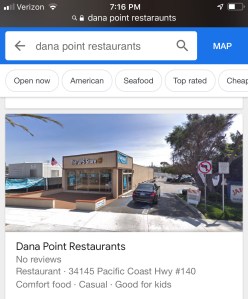
When I Google “restaurants,” what comes up is a picture of a UPS Store, noted for having a casual atmosphere that’s good for kids.

DP Dining

The whole coastal town is dated. You can tell some of the homes still have shag carpets, wallpaper, and a can of spam tucked back in the pantry. You can tell.
I’m just looking for a decent restaurant, but in this town, dropping the name James Beard makes people respond with the sound a pirate might make. And that’s confusing for everyone.

The list of eating establishments seems to have interchanged and reiterated all possible nautical terms, the way Mexican Food restaurants can take four food items and make an entire menu.

Chart House, Harbor House, Harpoon House. Good God.
“Beach Fare,” I say to my companion, wondering if that means there’s just sand on your food when it comes to the table.

“This other place has ‘area sourced’ Mahe.”

“‘Area sourced’ probably means it’s from the Costco up the street.”

“Is there actually a Costco up the street? Should we just do that?”

“Is Mexican food too pedestrian?” We look at the reviews on a tiny screen. The reviews are good. We scroll through pictures of the restaurant and see a picture with the owner standing next to Vice President Mike Pence, and my companion says, “The Mexican looks so confused.”

“He does look confused. Like he’s asking his staff, ‘You guys served this asshole?’ ”

We continue our search:

The Waterman’s Harpoon. The Longboard Chart Harbor House View. Mike and Ted’s Charter House View at the Harbor Lighthouse. The Harbor Grill Restaurant. Harpoon Henry’s. Waterman’s Harbor.

I would trade every harpoon, harbor and chart in a 10 mile radius for and anything involving kale, but do not say this aloud.

“These places all look like they serve fried calamari with a side of ranch.”

We capitulate and decide on Mike and Ted’s Charter House View at the Harbor Lighthouse. As we slide into the wicker seats and take in the view of overweight and oddly-shaped people lumbering about outside on the harbor, a young and overly-eyemakeuped woman brings us water in plastic cups and asks, “How y’all doin?”

My companion wastes no time in ordering the fried calamari as an appetizer, and asks, “Does that happen to come with a side of ranch?”

“Everything here with comes with a side of ranch, sir.”

HOME / ABOUT / RADIO / BACK TO TOP

Baby Names

Read Time: 01:27

It had been two years since I talked to one of my best friends from college and that’s how I found out she had had the baby. So of course I ask what’s the baby’s name and she says, “Tiegen.”

And I think OK, so that’s how that’s going.

***

I’m at the wedding of a good friend, Lisa, whose brother, Tom, is officiating. When I meet Tom, I understand that he is gay. A plot twist is introduced, however, when I later meet his wife (a lifestyle blogger) and their child.

Afterwards, I ask my friend Lisa, “What’s your brother’s kid’s name again?” And she says, “Isla Skye.”

I muster incredulousness to remain polite. “Ah. That’s a family name?”

“No. It’s a fucking blogger name.”

***

I was probably ten years old before I realized that Margaret and Aunt Peggy were the same person.

***

Six calendar days before her wedding, an announcement made on slices of printer paper in Arial font arrived through the mail: the event was off. Even the bridesmaids received the news this way.

Uncomfortably soon after, the bride-to-be married a different man who happened to be a billionaire, but no bridesmaids were involved. Their charming story was printed up on glossy magazine paper and distributed, and they talked about how they named their first-born son after their favorite Underground stop in London.

What a hoot it must have been to ride the Underground!

***

On the last girls’ trip, a wife had her sons’ names tattooed in very fine script under her arm, where even a bathing suit or a bra would cover them.

The husband knew some things about the girls’ trips, but he didn’t know her friends inspected the garbage can in his wife’s bathroom after her trainer would leave.

That which is named cannot really hide, and although hiding is usually very obvious, no one acted as though this were true.

HOME / ABOUT / RADIO / BACK TO TOP

Things are Hard to Name (and Hard Things to Name)

Read Time: 02:23

There are two reasons I write.  

First: a dream I don’t remember now, but one I did write down. The record of this dream is a torn, half-scrap of paper in the box labeled “Most Important.” It reads: “I cut myself to write with blood I had no ink. Who is a philosopher has gold in his bones.”

Second: also from the “Most Important” box, a newspaper clip from the New York Times, June 17, 2018, with the title, “What Kept Me from Killing Myself.” The article is written by a recovering alcoholic and Iraq veteran, and the first sentence is, “Books saved my life.” The author is unnamed.

***

Five years ago, I wrote a real nice, blowhardy essay about ‘Why I Write.’ Most every writer—especially if you have an ISBN number and a black and white photo with your dog on the back sleeve of your book—feels the need to make such a statement of purpose.

Time has a way of eroding things and changing us, and sometimes we better understand what is simple, smooth, essential and good only after some time has passed. This is to say that reading ‘why I write’ from five years ago was annoying—annoying like the black and white author/dog pictures. (Use the word armchair, here. It fits, and is super annoying.) 

The honest-to-goodness care with which I wrote the piece feels juvenile. It is a delightful piece in many ways, but perhaps too hopeful. The perfect title for it, if I could re-choose, is already in use by another author, Durga Chew-Bose: Too Much and Not the Mood.

(Cf. Why I Write: 1. Because if I don’t write it, other people will)

I do not have a ISBN number and I have never had a dog, and yet at one point I answered ‘why I write’ with alarming alacrity. I was finally able to tell you, reader. I was excited for you to know. I was finally able to elucidate each ‘why’ and I numbered them one through seven. I wrote this in 2014, and it is in many ways a love letter to you, reader. A love letter I never delivered. I never published it anywhere at all. 

Of course there’s a whole different world of ‘why’ behind that failing, and the ‘why’ of failure and love is especially hard to name for uncountably many reasons. When we touch things like failure and love with precise language, it makes the experience decidedly real, completely palpable and totally true. The starkness of language which names and talks openly about love and failure is at first humiliating and then, much later, if we don’t die of that humiliation, healing.

***

Five years ago, I made a definite statement regarding ‘Why I Write,’ using seven illustrated points with reasons and references (move the armchair over here).

Now I have only two reasons, and though they are immutable derivations of the original ‘why’, they are also far less exact, the movement of a cloud formation you once knew the name of.


HOME   /   ABOUT   /   RADIO  /   BACK TO TOP

On Wilshire Boulevard

Sunshone, oily old lady, slow
along a melting boulevard
with pink toggle lips,
loony but a propos.

Sheeny shoes, dragging 
and dropping her down the boulevard
of dirty sunshine.

She dribbles down the boulevard,
sweat dislodging the shoes, 
she attempts to smooth gawky steps
and terribly uncomfortable years.

Just before the boulevard, 
I imagine her heartfully applying
that crooked lipstick, 
as her wobble arms jig and sway
in the full length mirror. 

And then the same arms, 
reach gleefully
for the sofa print brocade shoes 
now demising her.

                 HOME   /   ABOUT   /   RADIO  /   BACK TO TOP

A Look at Public Transportation

Read Time: 01:30

Riding the subway in New York City is a moveable feast if you enjoy people watching. The only thing is to not stare at someone too long. They might stab you.

***

In Italy, riding the Metro is different–especially in the summer, when the absolutely murderous heat and the second-world air quality affects your disposition. In Italy, it’s so hot and pressed and populated that when you come eye to eye with someone riding the Metro, there are mere inches between your sweaty faces, but you don’t look away. Everyone’s just there in agreement that it’s goddamned hot and hey ho this is humanity.

***

In NYC, the homeless people have a gig in the subway cars. They pitch. They pitch their needs (whether asking for money, food or feminine hygiene products), and they do it better than I’ve seen some CEOs pitch their own businesses. NYC should hire homeless people to teach big business about how to sound sincere, how to sound urgent in their pitches. During these pitches, most riders avert their eyes to the floor, to their phone, or to the most recent issue of The New Yorker.

***

My first trip to Italy, I was about 30 and I went to visit my mom. She’d had an apartment there (an entire life, actually) for a few years, and I wanted to know about it. So I visit. One summer day we take a bus to Porta Portesi. It is Dante’s seventh-ring-of-hell hot, and there’s an old man standing behind me on the bus. It’s so hot and populated and pressed, and I can feel his erection poking through his pants on the side of my thigh so I turn my head and all I see is his wide, unapologetic and beautifully crooked  grin.

And I’m just there, in agreement, that it’s goddamn hot and hey ho this is humanity.


HOME   /   ABOUT   /   RADIO  /   BACK TO TOP

The Art of Prayer

Read Time: 03:29

For a long time when I was little, I didn’t know all the words to the “Our Father,” let alone what the prayer meant. Memorization was new, and because I could only remember as much as I could get through in the first breath,  I would repeat what I knew, over and over and over, exactly as long as it took everyone else to finish.

“On Earth as it is in Heaven.” 

Years later at an immersion school, we would have to memorize the same prayer in Spanish. I was at the age where hearing something enough times lead to the belief that you could fill gaps in understanding with random but approximate words, the way we did with song lyrics and philosophy.

“Y perdona nuestras dudas como nosotros perdonamos nuestros dudas.”

More time has passed and now Churches are just wonderful architecture. Prayers are an empty vase we send to sick people so they have a place to display their modest bouquets of hope. Memorization in the age of The Google is not a skill, but a cocktail-party affectation.

The only place I am invited to some semblance of prayer anymore is during yoga classes which are filled with excruciatingly good looking and much younger people.

I don’t care for young people the way I care for older people. I think everyone younger than me should be relegated to jobs at Trader Joe’s, and when I meet in person, for example, the successful artist whose bio said he was born in 1993, I feel form on my face a million microexpressions of judgment, the likes of which even $800 worth of Botox can’t suppress.

One afternoon in yoga class, the instructor announces that my “breathing is incorrect,” and a red, humiliated feeling one should not feel during a meditative practice wells up in me. I assume she is trying to help by making such an assessment, but all I understand is that this woman, this woman whose only fatty aspect has been syringed into her lips? She just informed the entire class that I can’t manage a basic autonomic function.

And she’s not wrong–that’s the worst part. I actually do spend a bad amount of time in yoga class thinking about smoking cigarettes.

To end the class, the instructor gives us a mantra. Her cartoon lips drip monotonous, meaningless-to-me syllables: Ra Ma Da Sa Sa Say So Hung. 

We repeat the incantation. And we repeat the incantation. And we repeat the…and I’m saying, “Ma Ma Ma Say Say Say Hung,” and I don’t care that it’s wrong, so I keep saying it because our voices, voluminous, fill the space up to the roof beams, and no one can tell I’m so wrong anyway and the whole, low tone starts to soothe, rumbling slow through my chest.

Ra Ma Da Sa Sa Say So Hung.

The instructor who we cannot see because our eyes are closed now, is, in my mind’s eye, a plumped and glossy, pouty mouth, bulbously but with perfect teeth articulating: Ra Ma Da Sa Sa Say So Hung. 

It sounds like a Lady Gaga lyric. It sounds Vietnamese. Ra Ma Da Sa Sa Say So Hung. It sounds like a jazz singer working out phrasing with no words.

Mantras need doing 108 times, and who knows if we’re even at 40 yet. There’s still time to get it right, I think, though I’m lucky if I make it to the end Ra Ma Da Sa Sa Say So Hung because usually I give up in earnest before then. It’s hard, man, Ra Ma Da Sa Sa Say So Hung How are these even words?

Sure-definitely I do not know what it all means Ra Ma Da Sa Sa Say So Hung big picture, or if this’ll fix my chakra? Plus we been doing this a minute now, man Ra Ma Da Sa Sa Say So Hung if I could just get it right just a couple times, seriously, a couple times in a row Ra Ma Da Sa Sa Say So Hung I should have it memorized by now what are we at like 80 now Ra Ma Da Sa Sa Say So Hung seriously how can you not remember something when you’re listening so hard, Jesus Ra Ma Da Sa Sa Say So Hung it’s the same every time and you heard it so so many times already.

Every incantation I get at least one syllable wrong; and every incantation I’m one syllable closer to getting it right.

HOME   /   ABOUT   /   RADIO  /   BACK TO TOP


Authors’ Note

Read Time: 01:03

Writers who know they are writers from a young age often spend half their lives denying that they should become writers at all. This may be common of many artists who do not inherit the industry.

Really good writers sometimes (instead of writing) will read everything decent under the sun and further convince themselves that they could never be a writer and everyone else already did it better anyway.

–It’s either that, or they convince themselves that they are already a better writer than everyone they’ve recently read, despite not having written anything new for months except lists of household tasks that also remain incomplete.

When reading as a writing-avoidance-technique, the writer often runs up against writing they are sure they could have created. Of course they didn’t create that writing, having been far too busy cleaning the cats’ litter boxes (or busy with some other anti-social pet or activity), creating hackneyed water color pictures (business a writer has no business doing), or drunk-dialing friends to leave voicemails about the next piece of writing which should be written (but probably won’t be), and which is based on another thing just read while avoiding writing.

Every writer looks forward to the day that the publisher sends that thin note saying, “Thank you. Your first book can’t look like this.”

HOME   /   ABOUT   /   RADIO  /   BACK TO TOP


Every Good Boy Does Fine

Read Time: 01:12

Before I’d even met him, my idea was to end up in Malibu like it was still the 60s, where music and art and writing and complicated relationships were the things.

Still, he didn’t mention that he was married when I met him.

He couldn’t read tablature, but he was a good enough guitar player that his Laurel Canyon friends would ask him to play at art openings or dinner parties hosted by Vogue people. He played stylized covers. It was fine enough.

He invited me to one of these numbers up on Wilshire, an art opening where he was playing, and there was an open bar. I left with a beautiful art book and a new Moleskine gilded with the gallery’s emblem, though they weren’t necessarily giving them away.

About the fact that I had just stolen beautiful books from an art gallery where he performed, he said, “Bonnie & Clyde.”

Later, he’s telling me about his cheating wife, and each pour of the 2015 Rombauer Merlot is warming a perilously close confidence. Everything he says feels like an admission, but to me, admissions feel like secrets. Admissions talk like they’re related to honesty and truth, but they’re second cousins at best.

He said, “I could love you.”

I said nothing.

He said, “So then, hire me as your assistant when you make it.”

I said, “You can’t even read music. You have to learn to read music.”

And he said, “That’s fine.”


HOME   /   ABOUT   /   RADIO  /   BACK TO TOP


Obit 7 (for the Robin’s egg)

Obit 7 (for the Robin’s egg)

I was mowing the lawn and trying to do it like the golf courses, like I liked. 

I stopped short right by the base of the pear tree because I didn’t want to run over the anomaly. I had fixed the mower enough times to not make this mistake again. 

I released the gas, the motor purred to quiet, and I approached the bright blue ball. It wasn’t a toy; it was a robin’s egg. 

I had never seen one before but I knew what it was when I saw it. There’s no mistaking that most perfectly unbelievable turquoise.

I looked up at the barren pear tree, not yet flowering, a spectacular bony structure against the white winter sky. I saw the nest, visible and vulnerable. 

I got the tall ladder and a pair of sterile gloves from a first aid kit, knowing that the egg would be useless if there was a whiff of humanity on it. 

I placed the egg back in the nest with a sinewy, tall, hopeful reach. 

When I got back down the ladder, I reflected on how much care I’d taken in something no one else would ever see. 

And I knew my 15 year relationship was over. 

I went out the next morning, dragging out the tall ladder again to check on the egg in its nest.

And what can I say?

There were just too many crows in that neighborhood. 

HOME   /   ABOUT   /   RADIO  /   BACK TO TOP

Obit 6 (for the obits)

Obit 6 (for the obits, as they were)

With these obits, I never meant to trick you into poetry.

If anything, that two-time poet laureate of ours Billy Collins tricked you first when he wrote that book called, “The Trouble With Poetry.”

I know that you know that there’s a lack of poetry in our lives. This is as obvious and honest as unfinished wood is prone to splinter.

Without poetry, Nabokov wouldn’t have painted in pointillism the beautiful nuance of disappointment in humanity. Without poetry, Lydia Davis wouldn’t have captured the horror and disgust of a lingering dog fart. Without poetry, we’re just a sequence of mad, missing moments.

But still, I don’t want to trick you into it. I was just trying to impress you. I didn’t mean the poetry to be pretense.

So join us today in celebrating the death of the poetic obit, where the first-person ordinarily yields to the third-person. Today we celebrate the first-person taking charge, despite its always having been the far less trustworthy narrator.

HOME   /   ABOUT   /   RADIO  /   BACK TO TOP

Obit 5 (for the childhood home)

Obit 5 (for the childhood home)

Even before Mother passed, she felt like one of those ghosts that could only go home. 

The house had always been her best friend: close when needed but otherwise far enough away.

There was no debate about the childhood home that would go to her brother, even though the home had been the only stable thing in all her life, all 40 years (stability not being a trait passed along by the gene pool).

The house was eccentric. Mother had covered the walls, both inside and out with something between frescoes and tromp l’oilel.

She went over one bright Tuesday morning with a handheld circular saw. 

She started in the dining room, where Mother had painted three villas (one for each of them) along the longest wall. Hers was the villa at the top of the hill, two black and white cats along the stacked stone walls. 

She went into the sitting room, where the drawn cathedral windows on the opposite wall mimicked those from Mother’s apartment in Italy. She cut those out, too. 

She went into Mother’s bathroom, painstakingly cutting around the tile, removing the pastoral. 

She went into the kitchen, removed the alla prima. 

She stacked each piece of drywall in the back of the truck, fabric between each. And then she returned to the guest bathroom, where her brother lay slumped, crumpled in the bathtub, and the saw started to sing again.

HOME   /   ABOUT   /   RADIO  /   BACK TO TOP

Obit 4 (for those who keep stars on hand)

Obit 4 (for those who keep stars on hand)

She was six when she learned about Orion’s Belt. The constellation matched the three equidistant freckles on her left hand, the only real reason it was of interest. She knew she was part of something larger, and that was enough to know.

The constellation is easy to see in Winter’s sky almost anywhere, and it always shows around the time of the Epiphany.

The three stars are technically blue giants or super blue giants, meaning that they will still be recognizable long after other constellations will have distorted into new configurations.

She had read somewhere, could not forget the idea that you only ever die the last time someone says your name.

Winter again, in the suburban driveway of her childhood home, but far, far from childhood. Surrounded by moving boxes from two different storage units, two different cities, two different relationships (and more bad decisions than that), she scans the night sky and finds Orion’s belt again. 

From her ex’s backyard on New Year’s Eve in Los Angeles, she had also seen the stars, then an admonishment. The stars were were with her still later, enduring a lonely, polar winter on Long Island, too. They were there the entire winter in Rome, too, hung every night above the Vatican no earlier than 9.

She mistrusted the lines on a map, was daughter to many philosophies, and spent a lot of time marveling at how well-tailored to its humans the scale of the earth was, even its winds and rains.

She was born in Summer but waited for Winter.

Join us in celebrating all those who keep stars on hand as a rejoinder to the giant question-mark of the universe, a reminder of the origin of the iron in our blood.

HOME   /   ABOUT   /   RADIO  /   BACK TO TOP

Quaint Notes on Ruin

Read Time: 0:30

“I bet the two of you could move mountains. I bet you could,” said someone addressing our couplehood.

–And we did move mountains.

And in the process, we made it hard where it could have been soft, and called it ancillary where it was necessary. All of our years together now talk behind our backs, making us out to be avaricious, idiot fools because we did move mountains.

We leveled off some really beautiful mountains, thinking that that would rid us of valleys of misunderstanding. We backfilled emptiness. Topography knows that without mountains, we’d have no valleys. But we called it development; we called it progress.

HOME   /   ABOUT   /   RADIO  /   BACK TO TOP